
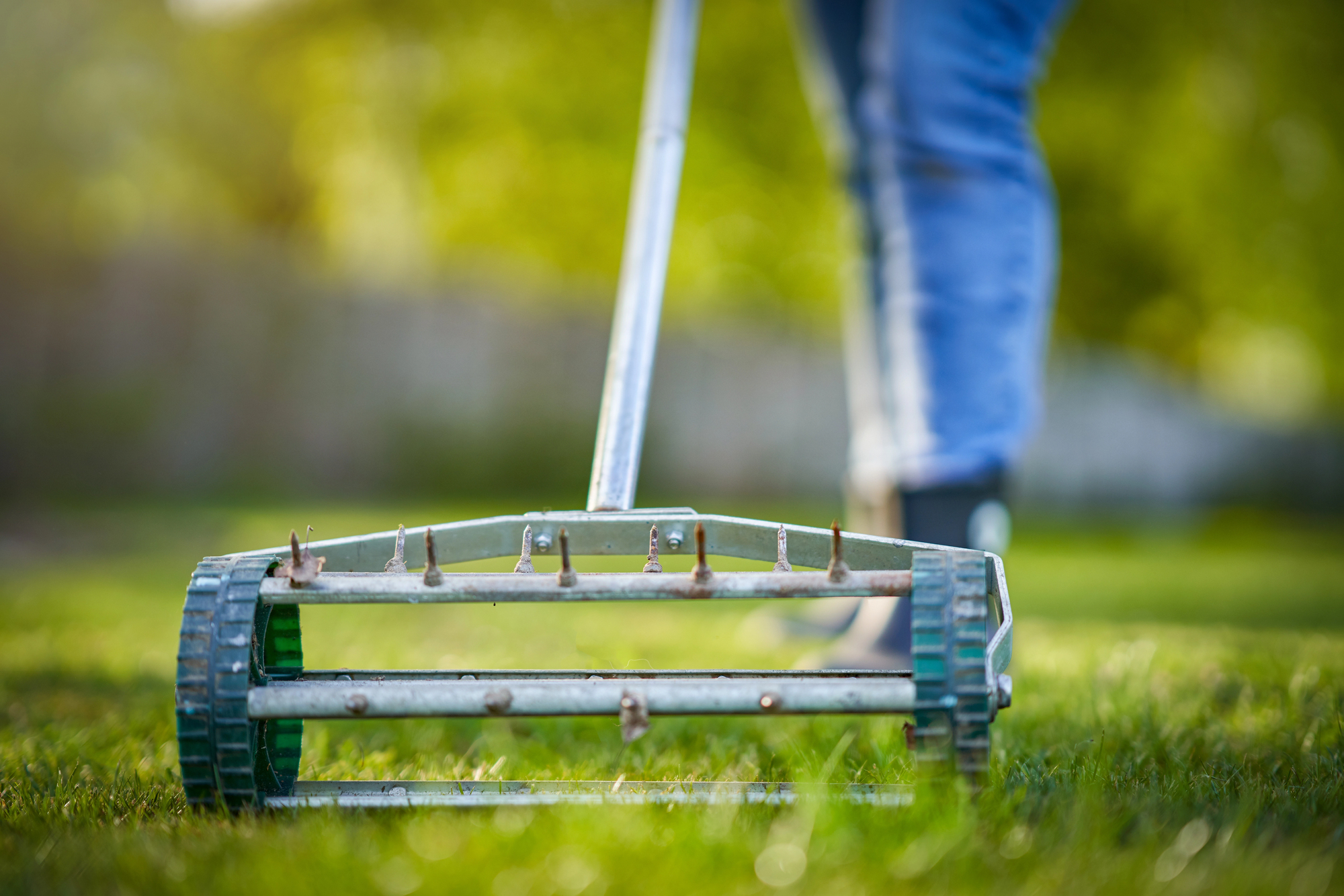
- Standing water and a spongy, squelching surface are signs that the soil underneath has been squeezed tight, not that the lawn is simply too wet.
- Driving a garden fork deep into the turf across autumn opens that soil back up, lets rain drain away, and gets air down to the roots before winter sets in.
- Brush sharp sand into the holes and feed the roots in the same week, and the ground firms up into a drier, stronger lawn by spring.
The water is not the problem. The squashed soil under it is.
If rain sits on top of your grass in flat grey pools and the ground gives a wet squelch underfoot, the lawn itself has not gone wrong. The soil below it has been pressed so tight that water and air can no longer move down through it. The fix is to open that soil back up, and the weeks from September into October are the best stretch of the year to do it. Push a garden fork deep into the turf, work your way across the whole wet area, and you give the rain somewhere to go and the roots something to breathe.
Healthy soil is roughly half solid and half empty space. Those gaps, the pores between the grains, are what hold air and let water trickle down to the roots and away. Foot traffic, children playing, a heavy mower passing over the same lines every week, and naturally sticky clay all crush those pores shut. Once the gaps collapse, rain has nowhere to drain, so it backs up and lies on the surface. The Royal Horticultural Society describes the tell-tale signs plainly: a lawn that feels squelchy when you walk on it, water that puddles after rain and drains slowly, and a sticky, glue-like layer of soil near the surface.
The grass suffers twice over. Roots need oxygen to take up water and nutrients, so waterlogged, airless soil starves them and the fine roots begin to die back. Where the better lawn grasses drown, moss moves into the wet surface and coarser, rougher grasses take over the gaps. Leave it long enough and a lawn that floods every winter slowly turns into a patchy, mossy, weed-grass mess. Opening the soil up again is how you stop that slide.
Spike it with a fork, the cheapest fix there is
For most lawns, a garden fork is all you need. Drive the tines straight down into the turf, rock the handle from side to side a little to ease the holes open, then pull the fork out and move on. The RHS advice is to go down as deep as the tines will reach, ideally 10 to 15cm (4 to 6in), and to space each set of holes 10 to 15cm (4 to 6in) apart across the whole area. Every hole becomes a channel: a route for standing water to drain down and for air to reach the root zone. On an average lawn, doing this every two to three years keeps the soil open.
Timing and soil condition matter more than muscle. Work when the ground is moist but not flooded. Bone-dry summer soil is too hard for the tines to bite, and a waterlogged lawn is too soft to hold the holes open, so autumn, after the first proper rain has softened the surface, is the window. A sturdy digging or border fork costs about 20 to 35 pounds (roughly 28 to 48 US dollars) from the likes of B&Q, Screwfix or Wickes, and it will outlast any gadget. Spiked aerator sandals that strap over your boots run about 10 to 15 pounds (roughly 14 to 20 US dollars), and they can help on a small lawn, but the spikes are short and they do little on heavy ground. The fork reaches deeper and does the real work.
One warning. Do not keep walking to and fro over a soaked lawn while you wait for a dry day to start. Every footstep on saturated ground presses the soil tighter and undoes the very thing you are trying to fix. Stay off it until it has drained enough to take your step without squelching, then aerate.
When a fork is not enough: hollow-tining heavy, wet ground
On heavy clay, or on a lawn that floods in the same spots every winter, solid spiking with a fork can close straight back up again as the wet clay squeezes shut around each hole. This is where hollow-tining earns its place. A hollow-tine aerator pulls out plugs of soil, a core from each hole, and leaves wider, longer-lasting openings behind. The RHS rates hollow tines as the better choice for clay or waterlogged lawns, noting they make wider holes that are even more effective at letting air and moisture into the root zone. Hollow-tining is harder work, so once every three to four years is enough.
The step people skip is clearing up afterwards. Those soil cores must be raked or swept off the lawn, not left to break down where they fall. Leave them lying and they smear back into a thin layer over the surface, sealing the very holes you just made. Sweep them up and add them to the compost heap or the bin. A hand hollow-tine aerator costs around 20 to 30 pounds (roughly 28 to 42 US dollars). For anything bigger than a modest back garden, a petrol or electric aerator hired for the day will save your back and get the job done in an hour.
Brush sand into the holes and feed the roots
Holes on their own help, but they close over time. The trick that keeps them working through winter is to brush a free-draining sharp sand into them straight after aerating. Sharp sand, sometimes sold as grit or horticultural sand, has coarse, angular grains that hold the channels open and let water keep moving. Do not reach for soft builder’s sand or fine play sand: the tiny rounded grains pack down and set almost like cement, which makes drainage worse rather than better. The RHS suggests a top dressing at about 2 to 3kg per square metre (4 to 7lb per 10 square feet), and a mix of three parts sandy loam, six parts sharp sand and one part well-rotted compost works into the holes and over the surface. A 20 to 25kg bag of sharp sand is about 5 to 8 pounds (roughly 7 to 11 US dollars). There is a fuller method in our guide to top dressing a lawn in autumn.
Feed at the same time, but reach for the right feed. An autumn lawn feed is low in nitrogen and higher in potassium, and that balance pushes the grass to build roots through the cold months rather than soft, sappy top growth that frost will blacken. The RHS puts it simply: autumn feed encourages root growth through winter, rather than leafy growth. Spread it just before rain is forecast so it washes in. A box runs about 10 to 18 pounds (roughly 14 to 24 US dollars) and covers most domestic lawns. This is the part that turns a wet autumn job into a spring payoff: deeper roots and open, drained soil mean firmer ground underfoot and a lawn that greens up faster and shrugs off the next dry spell.
What happens if you leave it, and when to call in drainage
Ignore standing water for a season or two and the damage compounds. The airless, sodden surface is exactly what moss wants, so a green film creeps across the wet patches. The fine lawn grasses rot off at the root and rougher weed grasses and rushes move into the gaps. The roots that survive stay shallow, sitting near the surface where the air is, which leaves the whole lawn quick to brown and flop the moment summer turns dry. Aerating now heads all of that off. If moss has already taken hold in the wet areas, our guide on clearing moss without scarifying to bare soil covers the next step.
There is a point where a fork cannot win. If the whole garden sits on heavy clay and floods every single winter no matter how often you aerate, the problem is the ground itself, and you need to give the water somewhere to go. That means a drainage system with a proper outlet, a soakaway, a ditch or a drain, so the water running off the surface has an exit. On the worst ground, stripping the turf, digging in plenty of organic matter and a 5cm (2in) layer of sharp sand, then reseeding, rebuilds the soil from the bottom up. For most lawns, though, it never comes to that. A fork, a bag of sharp sand and an autumn feed, done in the right week, are enough to firm up squelching ground before the cold arrives.