
Topdressing is the step that takes a passable lawn and turns it into the kind of surface people stop and ask about. It is also the step that most home gardeners never attempt because they think it is the sort of thing only professional groundsmen do. The reality is that spreading a thin layer of the right soil mixture across a lawn in late spring is one of the cheapest, simplest, and most underrated jobs in the gardening year. It levels small bumps and dips, feeds the soil biology, improves drainage, and gives any overseeding work a far better strike rate than seeding alone.
The science behind it is straightforward. Lawn soil compresses, washes, and degrades with every season of mowing and footfall. The top centimetre or two loses organic matter as it is grazed off by the mower, and the rain rinses fine particles downward through the profile. Adding a thin layer of organic-rich, well-structured material restores what has been lost without disturbing the existing grass. Done in late spring on a warm, actively growing lawn, the grass blades push back up through the dressing within a fortnight and the entire surface is incorporated naturally into the root zone.
Why Late Spring Is the Best Window
The two best windows for topdressing are late spring (May to early June in temperate regions) and early autumn (September). Late spring works because soil temperature is high enough for fast grass recovery, soil moisture is usually still adequate after spring rain, and there is a long growing season ahead for the dressing to integrate into the surface profile. Autumn works for similar reasons in reverse, with warm soil cooling slowly into dormancy.
BBC Gardeners’ World recommends topdressing in late spring once the lawn has had its first few mows and is actively growing. The reason is simple: grass plants that are growing strongly recover quickly from being temporarily covered, and the dressing has full summer to be worked into the surface by rainfall, mowing, and earthworm activity. Earthworm activity is particularly important because earthworms incorporate dressing into the soil faster than any other mechanism. A lawn dressed in May and watered well shows complete integration by July.
Doing it earlier than May, when soil is still cold, slows everything down. The dressing sits on top, the grass grows slowly, and the surface looks patchy for weeks. Doing it in midsummer is worse because the dressing dries out quickly, the grass underneath is heat-stressed, and the new material can scorch tender blades. Avoid August and the first half of September if temperatures are still high. Late September works once the heat has broken.
What to Use and Why the Mix Matters
The classic lawn topdressing recipe used by professional groundsmen is six parts sandy loam topsoil, three parts sharp sand, and one part peat-free compost or sieved leaf mould. The sand opens up the soil structure and improves drainage. The loam provides body and nutrients. The compost feeds soil biology and adds organic matter that the surface loses over time.
For most home gardens, the easiest option is a pre-mixed lawn dressing bag. Westland Lawn and Turf Dressing (25 litre bag at B&Q for around £10/$13 per bag) is a sand-loam mix designed specifically for spreading on lawns. One 25-litre bag covers roughly 12 square metres at the right depth. A typical 50 square metre lawn needs four bags (around £40/$50 total) for a full surface dressing. Rolawn Turf Dressing (25kg bag around £14/$18) is a higher-loam alternative that suits clay soils less well but works on lighter sandy ground.
Avoid using straight builder’s sand, ordinary multi-purpose compost, or topsoil from a garden centre that has not been described as a lawn dressing or sand-loam mix. Builder’s sand is too fine and packs into the surface in a way that suffocates grass. Multi-purpose compost is too rich and rots quickly. Bagged topsoil often has lumps and stones that catch in the mower and ruin a sharp blade. The mix has to be screened to about 5mm (a fifth of an inch) so it can be spread evenly without leaving lumps.
For seriously uneven lawns, professional groundsmen mix more sand into the dressing (up to 70 per cent sharp sand) and use it specifically to level dips and shallow depressions. This is more work and more material but produces a flatter surface over two or three seasons of repeat dressing.
How to Apply It Without Smothering the Grass
The application depth is the single most important detail. Spread no more than 6 to 8mm (about a quarter of an inch) at any one pass. At that depth the grass blades poke through, photosynthesis continues, and the lawn recovers within a fortnight. Spread thicker than 12mm (about half an inch) and the grass underneath suffocates, yellows, and may die in patches.
The cup-of-coffee test works well: a 25 litre bag holding lawn dressing should cover an area roughly the size of a single car parking space (around 12 square metres) at the right depth. If you find you have material left over after that area is covered, your layer is too thin. If you run out before reaching the edges, your layer is too thick.
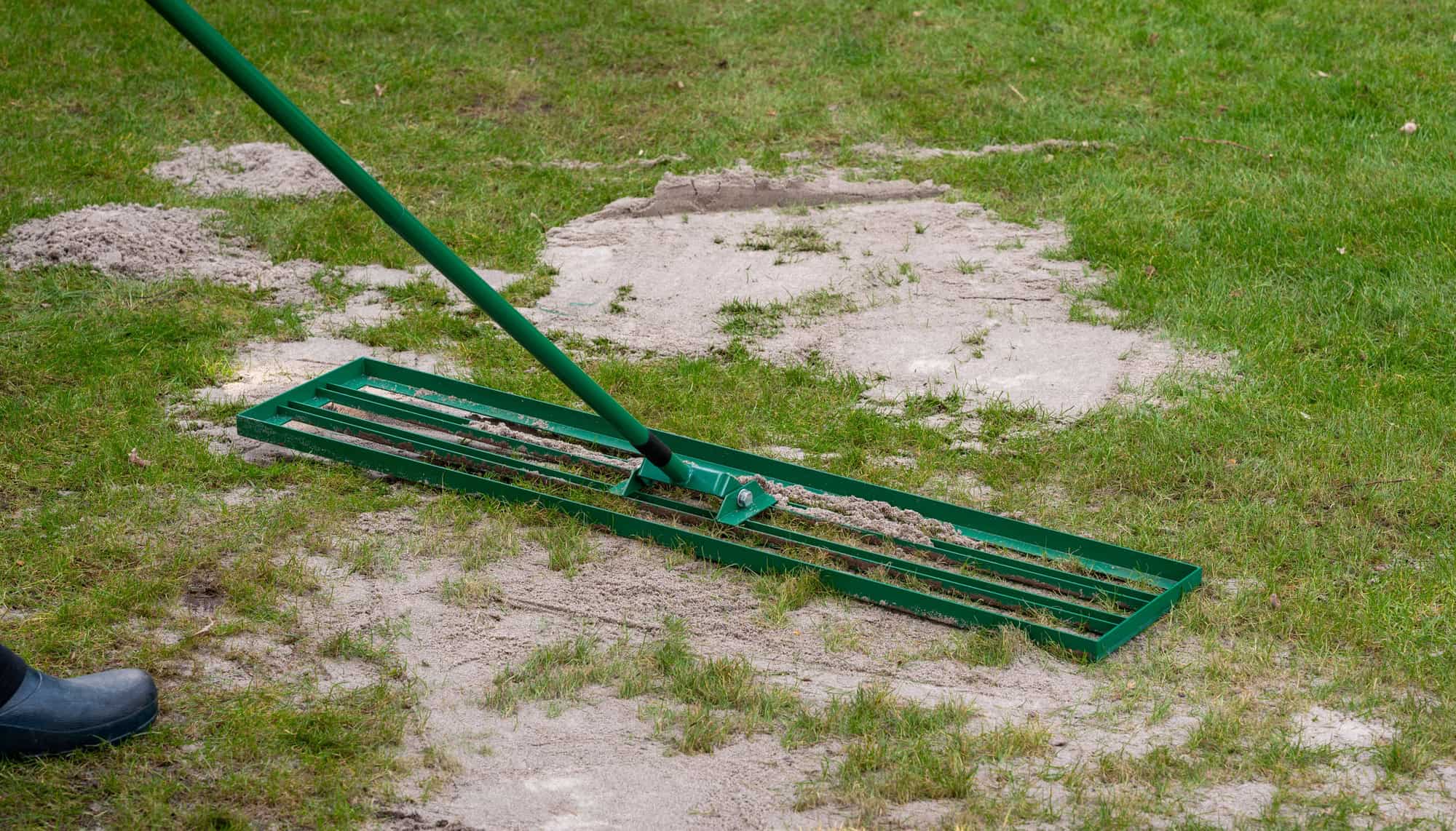
The most efficient way to spread it is with a stiff lawn rake or a purpose-built lute (a flat aluminium drag tool sold by suppliers like Greentek and Lawn Care Products for around £45/$55). Tip small piles of dressing across the lawn from a wheelbarrow, then drag the rake or lute across the surface to spread the dressing evenly. Work in one direction first, then a second pass at right angles to even out any streaks. The grass should still be clearly visible through the dressing once you have finished. If you cannot see grass blades, the layer is too deep and you need to drag more of the material off.
Water the lawn lightly after dressing to settle the material into the surface. About 5mm of water (around fifteen minutes from a typical sprinkler) is enough. Heavy watering at this stage washes the dressing off the high spots and into the hollows, which works against the levelling effect.
Combining Topdressing with Other Renovation Work
Topdressing on its own is useful. Topdressing combined with hollow-tine aeration is transformational. The sequence is to aerate first, leaving the cores on the surface, then sweep up most of the cores and apply the dressing on top. The dressing falls into the holes left by the aerator and reaches the root zone directly, rather than just sitting on the surface. The University of Maryland turf programme has shown that this sequence improves soil structure measurably within a single season.
For bare patches or overseeding work, topdressing acts as a near-perfect seed bed. Apply the dressing first, then broadcast a quality lawn seed mix like Johnsons Tuffgrass (around £15/$19 for 425g, covers 17 square metres) or Scotts EZ Seed Patch & Repair (around £22/$28 for 1.4kg) on top. Rake the seed lightly so it sits in the dressing rather than on it, and water daily for the first ten days. Germination rates with topdressing are typically 80 per cent or higher against around 50 per cent for seed broadcast directly onto unprepared lawn.
A spring feed at the same time accelerates everything. Apply a slow-release nitrogen-rich feed like Westland SafeLawn (6-1-3 NPK, around £14/$18 for 150 square metres) the same week as the topdressing. The dressing provides the soil improvement, the feed drives the leaf growth, and the lawn responds with the fastest two weeks of growth it will have all year.
What Goes Wrong Without It
A lawn that is never topdressed gradually loses its surface organic layer. Each mowing removes a small amount of leaf material, and each rain washes a tiny amount of fine soil downward into the profile. Over five or six years, the surface becomes thin, the soil structure degrades, and the lawn develops a tired, papery appearance that does not respond well to feeding or watering. Small bumps and dips become more pronounced because there is nothing to level them.
The consequence is a lawn that needs more water, more feed, and more weed treatment to look acceptable. The cost of those inputs over five years is far higher than the cost of two topdressings during the same period. A lawn that is dressed once every other year in late spring stays naturally smoother, drains better, recovers faster from drought, and resists weed pressure with less herbicide use.
Topdressing is not the most exciting job in the gardening year. It is dusty, mildly heavy work that takes a Sunday afternoon for an average garden. What it produces, though, is the kind of subtle, accumulated improvement that separates a lawn maintained by someone who knows what they are doing from one that just gets cut and watered. The grass is denser, the surface is flatter, the colour is deeper, and the lawn holds its quality through summers that would otherwise stress it.