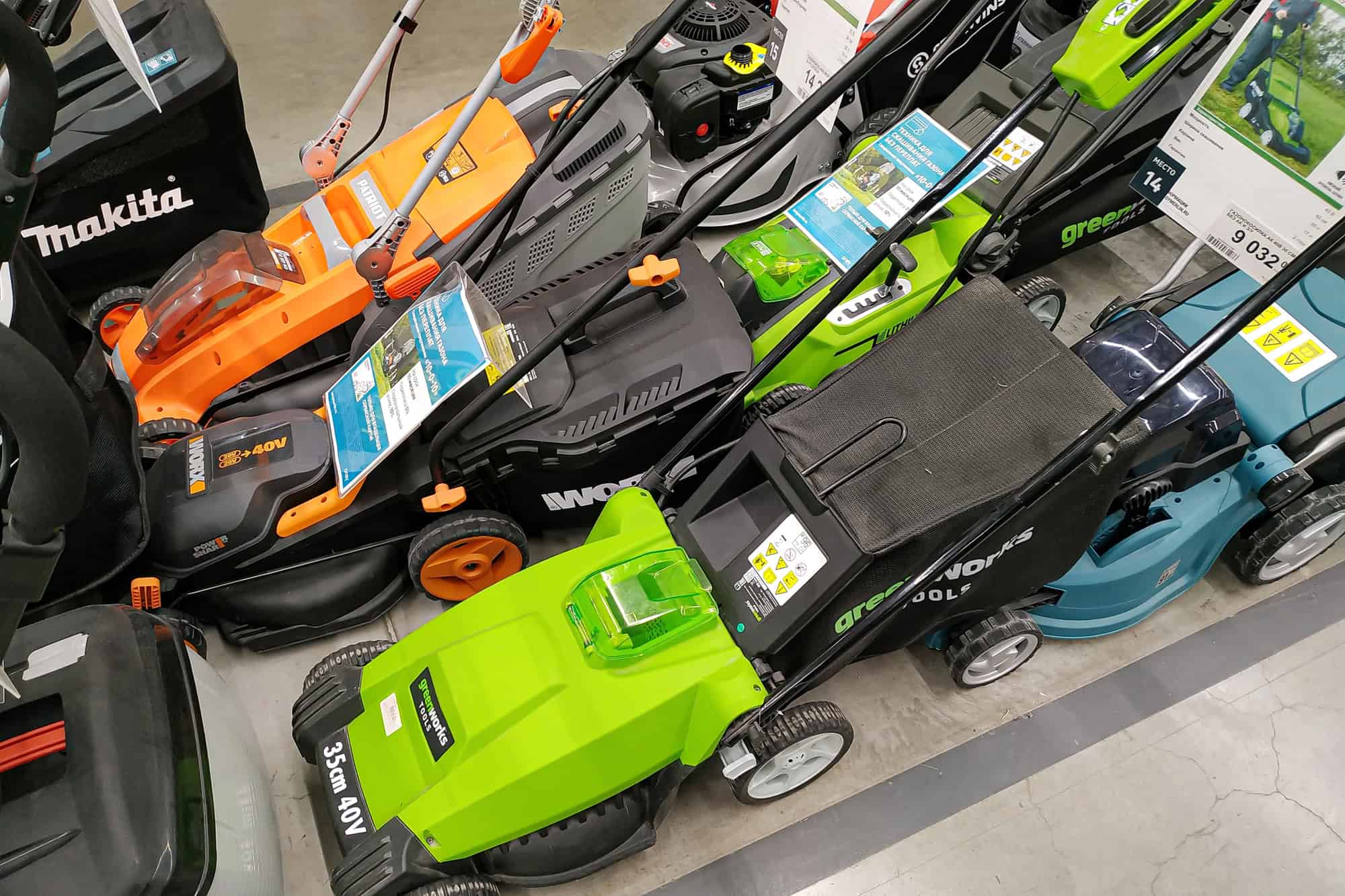
Greenworks builds one of the widest cordless mower ranges on the market, and the secret to buying well is matching the battery voltage to the size of your lawn rather than chasing the biggest number. For most small to medium gardens the 40V range gives the best balance of price, weight and runtime. Step up to 60V or 80V only if you are mowing a larger plot or want power that rivals petrol. Get the match right and a Greenworks mower will cut cleanly for years on batteries you can share across a whole shed of garden tools.
The appeal is easy to understand. There is no petrol to mix or store, no annual service, no pull cord and no fumes, and the batteries slot into strimmers, hedge trimmers, leaf blowers and more from the same voltage family. The catch is that Greenworks sells across several voltage platforms that look similar on the shelf but suit very different lawns, and buying the wrong one means either an underpowered struggle or money spent on capacity you never use.
How the voltage platforms differ
Greenworks splits its cordless tools into voltage families, and the voltage is really a proxy for power and how big a job the tool is built for. The headline figure is the peak voltage, so a battery labelled 40V is the same chemistry as one labelled 36V nominal, just measured differently. What you need to take from the number is the class of machine it belongs to.
The 24V range is the entry tier, suited to very small courtyard lawns and light trimming rather than a main mower. The 40V range is the heart of the lineup and the right choice for the majority of domestic lawns up to around a quarter of an acre (roughly 1,000 square metres). The 48V system is a clever middle option that runs two 24V batteries together, giving more power while keeping you on the affordable 24V battery platform shared with a large tool family. The 60V range steps up to medium and larger lawns with more torque and longer runtime, and the 80V range delivers cutting power that rivals a petrol mower, aimed at large gardens up to around three-quarters of an acre. Because batteries are only cross-compatible within a voltage family, the platform you pick is a long-term decision, not just a one-mower choice.
Runtime depends on battery capacity, measured in amp-hours (Ah), not on voltage. A 40V mower with a single 4.0Ah battery will cut for roughly 40 to 45 minutes in average grass, enough for a small lawn, while a larger garden benefits from a 5.0Ah battery or a two-battery setup so you are not waiting on a charger mid-job. As a rough planning figure, budget one amp-hour of battery for every 40 to 50 square metres of lawn you intend to cut in a session.
Which Greenworks mower suits your garden
For a small lawn under a quarter of an acre, the Greenworks 40V 16-inch push mower is the value pick, often around 220 to 280 pounds / 280 to 300 dollars with a 4.0Ah battery and charger included. It is light, simple, and its 16-inch (41cm) deck makes short work of a typical front-and-back garden. The push design keeps the weight and price down, which suits a flat, modest lawn.
For a medium lawn, or one with slopes where you would rather not push, move up to a 60V self-propelled model with a wider deck of around 21 inches (53cm). Expect to pay somewhere around 380 to 480 pounds / 450 to 550 dollars, and look for one supplied with a 5.0Ah battery or two batteries so runtime keeps pace with the bigger cut. Self-propulsion earns its keep on anything other than a small flat lawn, because it carries the mower’s weight for you and makes an even pace easy to hold.
For a large garden, the Greenworks 80V 21-inch self-propelled mower is the one that behaves most like a petrol machine, frequently found around 480 to 600 pounds / 480 to 700 dollars depending on battery count and any seasonal discount. The 80V platform has the torque to power through long or damp grass without bogging down, and a two-battery capacity to cover a large plot in one go. Greenworks tools are widely stocked at B&Q, Amazon, Home Depot, Lowe’s and specialist outdoor-power dealers, and prices move a fair amount through the season, so it pays to check current figures before buying.
If you are still weighing cordless against petrol in principle, our look at summer mowing technique applies whatever you buy, because cutting height and timing protect the lawn regardless of the machine.
It is worth knowing where Greenworks sits against its rivals, because the cordless market is crowded. Ego, built around a 56V platform, is widely regarded as the closest thing to petrol performance and tends to cost more, while Bosch and Flymo lean toward lighter, smaller-lawn machines at keener prices. Greenworks competes mainly on value and on the sheer breadth of its tool range across each voltage family, so its strongest case is for a household that wants to build a set of garden tools, mower, trimmer, blower and more, on shared batteries without paying a premium. Where it is less convincing is at the very bottom of the range, where the cheapest brushed-motor models cut corners that show up as shorter life and weaker performance in long grass.
Warranty and battery support are worth a moment too. Greenworks typically backs its tools with a multi-year tool warranty and a separate, shorter battery warranty, and because the batteries are the most expensive part to replace, buying into a voltage platform you expect to stay with protects that investment. Keep your proof of purchase, register the tool if the maker invites you to, and resist the temptation to mix batteries across voltage families, which simply will not fit.
What to check before you buy and how to make it last
Three things decide whether you are happy with a Greenworks mower a year later. The first is deck width against lawn size, because a deck that is too narrow turns a quick job into a slog of overlapping passes. The second is battery capacity, since an underpowered battery means recharging mid-mow and a mower that cuts out in long grass. The third is whether the model is brushless. Greenworks brushless motors run cooler, last longer and squeeze more runtime from the same battery than the older brushed motors, and on anything beyond the cheapest entry tools they are worth seeking out.
A worked example makes the battery maths concrete. Say your back lawn is around 200 square metres. Using the planning figure of one amp-hour for every 40 to 50 square metres, you want roughly 4 to 5 amp-hours of battery to cut it in a single session, so a 40V mower with a 5.0Ah pack, or a 60V model with a 4.0Ah pack, clears it without a recharge. Double that area and you either step up the battery capacity or buy a model that takes two batteries, swapping the spent one for a charged one mid-mow. Buying a single small battery to save money on a large lawn is the most common regret, because the charger becomes part of every mowing afternoon.
Caring for a battery mower is far simpler than servicing petrol, but a few habits extend its life. Store batteries indoors at room temperature and at around half charge over winter rather than fully flat or fully full, because extreme states of charge age lithium cells faster. Keep the underside of the deck clean, scraping off caked grass after mowing, since a clogged deck strangles airflow and makes the motor work harder. Sharpen or replace the blade once a season so it shears rather than tears, which keeps the cut clean and reduces the load on the motor and battery. Do those few things and the mechanical simplicity of a cordless mower, with no carburettor to gum up and no oil to change, means many owners get a decade of service from a single machine while passing the batteries on to the next tool they buy.