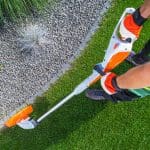
- Re-cut the lawn edge with a half-moon tool on a dry winter day and the grass has a clean line to stop at.
- A drop of about 7.5 cm (3 in) between lawn and border keeps plants off the grass and grass out of the border.
- Once growth returns, a trim with edging shears after each mow keeps the line crisp.
The Edge You Stopped Noticing in July Is the One That Costs You Every Weekend
Walk to the place where your lawn meets the border and look down. Grass has crossed the line. Blades flop over the soil, stems creep into the bed, and every mow leaves a ragged fringe that you then fight with a trimmer. The fix is one job in the quietest part of the gardening year: re-cut the edge with a half-moon edging tool, flick the soil away to leave a drop, and trim the line after each mow once the grass is growing again.
You do not need to lift any turf or reshape the lawn. This is a tidy-up of a line that already exists. Pick a dry day, work off a wooden board if the ground is soft, and the border has a clear boundary to keep. Redefining the edge every year makes the trimming easier, and trimming in spring, summer and autumn then stays quick and easy.
If your edge has collapsed or crumbled rather than crept, that is a different job, and you can repair a collapsed lawn edge by turning a piece of turf. Everything below is for the edge that is intact but swamped.
Why the Grass Ends Up in Your Border
Many lawn grasses do not sit still. Creeping-type grasses spread by stems that stretch out from the crown of the plant, and new shoots grow from nodes on those stems. Some run underground (rhizomes) and some run along the surface (stolons). In the middle of the lawn you rarely notice this, as the grass is dense and the mower keeps it level. At the edge, a runner reaches the border and carries on into the soil beyond.
Two gaps in the routine let it happen. The first is an edge with no drop, where grass and soil sit at the same height, so nothing marks where the lawn ends. The second is an edge nobody trims, so the blades lean out over the soil and the line blurs. Each year without a re-cut, the line moves a little further into the bed.
A cut vertical face deals with both. The spade or edging tool slices through any stem that has crossed the line, and the drop leaves the overhanging blades hanging over a gap instead of resting on soil. RHS advisers give a drop of about 7.5 cm (3 in) from lawn to border as the depth that helps keep plants off the grass, and grass out of the border. Their monthly calendar for November gives an 8 cm (3 in) deep gutter around the lawn, which reduces grass spreading into your borders. Both figures come to about 3 in, so cut to that depth.
Pick the Right Day and Gather Four Tools
Winter suits this job, with the gardening year at its quietest. An edge can be redefined with a half-moon tool at any time of year, and the cold months leave you the time.
The soil decides the day. If your ground sits wet through winter, wait for it to dry. Working on soaked soil compacts it and damages the lawn, so you press a squashed strip along the very line you wanted to improve. If the soil is only slightly wet, work off a wooden board. The board spreads the load of your boots, so you do not press a line of dents along the edge. Skip the job if the ground is frozen or very wet, and stay off a frosty lawn: grass blades go brittle in the cold, and footprints can leave brown marks that take a while to disappear. To see how wet soil suffers under load, read about mowing a wet lawn.
You need four tools.
- A half-moon edging tool, which cuts the vertical line. A flat-backed spade also works.
- Edging shears, for trimming overhanging grass once growth restarts. Long or telescopic handles help tall gardeners.
- A Dutch hoe or a spade, to draw the loosened soil away from the edge.
- A narrow rake, to gather the cut grass.
Keep the shears sharp. A sharp blade gives a clean cut and makes the task easier.
Cut the Line and Make the Drop
Start with the line. For a straight edge, tie a string between two canes or pegs and pull it taut at ground level. For a curve, lay a hosepipe, rope or string on the grass and move it until the shape looks right. Look at it from several angles: from an upstairs window you can see the whole shape at once. Broad, sweeping curves are easier to maintain than fussy curves or complex shapes, so smooth out tight bends now and save yourself the trimming later.
Now cut. Set the half-moon blade on the line and stand on its flattened top so it goes in fully. If you are using a flat-backed spade, wrap a strip of tape around the blade at 7.5 cm (3 in) and push to that mark. Work around the lawn in small steps, so that each cut slightly overlaps the last and makes one continuous cut. Keep the blade pushed downwards, which cuts away slivers of grass and leaves a clean vertical face.
Next, make the drop. Remove excess soil with a spade, or draw it away from the lawn edge with the hoe, flicking it away as you go until the border sits about 7.5 cm (3 in) below the grass. Lift the cut slivers by hand and slide the spade under any larger piece. Walk the line when you finish and look along it from both ends, then recut any spot that wanders.
Put the cut grass in the compost bin, or if there is a lot, stack it in a separate pile to rot down into soil.
One warning. Take slivers, not slices. Follow the existing line and cut away only what restores the face, so the lawn does not shrink a little more each winter.
Trim as You Go From Spring
The cut is the heavy job, and you do it once. The trim keeps the edge sharp, and you do it little and often. Use edging shears after each time you mow, as often as once a week when the grass is in full growth. Mild winter spells count too: grass keeps growing in temperatures above 7°C (45°F), so the edges can use an occasional trim before spring.
Technique makes the trim quicker. Hold the shears upright, with the blades beside the lawn edge. Keep the handle on the lower blade steady and move only the handle on the upper blade to cut the overhanging grass. Take small sideways steps with each cut slightly overlapping the last, then check for missed tufts.
Rake up what you cut. Make small piles and take them to the compost. Where you have only cut short sections, leave them or flick them into the border with the hoe to rot down.
Cut and trim as above, and the first trim of spring is a quick pass along a line that is already there.
How to Stop the Edge Going Ragged Again
Repeat the re-cut once a year. Redefining the edge annually makes trimming easier, and the December advice is to re-cut lawn edges with a half-moon edging iron or flat-bladed spade, to neaten the garden and save work next season, and to maintain an 8 cm (3 in) gutter. Put a reminder in your diary for the first dry spell of winter.
Shape the lawn for easy care. Broad curves beat fussy ones. If a stretch keeps beating you, installing wood or metal edging helps to retain the shape and makes trimming easier. A well-defined drop with a decent depth down to the border also keeps mulching material in place.
Keep the shears next to the mower, so the trim follows every cut. For a deeper look at the cutting technique itself, there is more on how to edge a lawn for a crisp border without buying expensive tools.
When is it time to call someone? If the lawn needs reshaping rather than re-cutting, as you are extending a bed or changing the outline, that is a bigger job. A new lawn edge can be created at any time of year, with the same rule: avoid working the grass if the ground is frozen or very wet. Mark the new shape with string or a hose, cut it, and lift the unwanted turf. If the area is large, hire a gardener for that single day, and keep the yearly re-cut for yourself.