- A second-hand mower tells you how it was used through its oil, its fuel, its controls and the size of the lawn it came from.
- Ask how long the seller has owned it and how often it was used, do the hours sum, and start it cold before any money moves.
- A dull blade, a dirty plug or stale petrol is a cheap fix, but a bent blade, worn bearings or a battery near the end of its life is a reason to walk away.
Why a Cheap Mower From a Shed Sale Can Cost More Than a New One
The fix is a short routine. Check what a new mower costs first. Read the oil, the fuel and the controls. Do the hours sum. Start the engine cold. If the mower passes all four, you have found a bargain. If it fails one, you have found somebody else’s repair bill.
Sellers of tired mowers talk about light use and careful servicing. The machine tells a different story. Consumer Reports says the tool itself will tell you the truth about how it has been used and cared for.
Start With the Price of a New One
Look at the cost of a capable new model first.
Natalie Brown, the Which? lawn mower expert, said this in 2026: “Our testing reveals you can buy great corded electric mowers from as little as £75 and cordless models that perform as well as the high-end models from £130, plus they’re all lightweight, which makes them easy to use, carry and store. Look for our Best Buy and Great Value recommendations.” At £75 ($100) and £130 ($174), any used mower priced near those figures needs to be in very good condition to beat a new one.
Size is the other half. Brown adds: “You might think bigger is better, but the reality is a typical UK home has a small to medium-sized garden under 150 sq.m, which makes spending more than £250 on a new lawn mower unnecessary. Instead of a buying ‘cheap’ mindset, think of it as buying ‘appropriate’ and look for the sweet spot: a premium mower with a 46cm cutting width and a 50-litre grass box is the equivalent of using a chainsaw to prune a rose.” A garden under 150 square metres (1,615 square feet) rarely needs a big machine.
Buying used also costs you things. You almost certainly give up the warranty, and you miss newer features such as electric start, which makes a mower easier to use. Search for recall notices before you pay. The testers poll tens of thousands of owners each year on repairs and breakages, and find big gaps between brands and between different tools from one brand.
Brown also says: “Cheaper mowers often have plastic decks and components with less powerful engines, while more expensive models come with aluminium or steel decks and commercial-grade engines.” A cheap mower bought used started with those weaker parts, and years of wear come on top.
What the Machine and the Seller’s Lawn Tell You
Start with the engine, and do it before the seller says a word. The red flags are sediment visible through a clear fuel tank and thick, dirty engine oil. Both say the fuel and oil systems have not been reliably serviced.
The reason is simple. Engine oil lubricates the moving parts and carries heat away from them, and it holds dirt in suspension until the next oil change. Oil that is thick and dirty, or low on the dipstick, protects less, so the bearings and other moving parts take the wear. Sediment in the tank says nobody has looked after the fuel system. Fuel left in a mower for an extended period, over winter for example, can go stale and stop it starting, and petrol with a lower ethanol content absorbs less moisture from the air. Low oil, dirty oil and a dirty air filter are all signs the engine has not been well maintained.
Next, the parts people touch. A frayed pull cord or a worn pedal on a ride-on shows heavy use, however well the machine was serviced. Spin the wheels. Worn wheels cause hard pushing, a wobbly feel and an uneven cut.
Then walk over to the seller’s lawn, a clue most buyers skip. The testers make the point with leaf blowers: a 3-year-old blower from a seller on an open lot is a better buy than a 1-year-old one from a house surrounded by deciduous shade trees, which drop a lot of leaves and mean more work for the tool. The same logic fits mowers. A large, rough lawn means more mowing, and more hours on the engine. A tiny courtyard patch means little use, whatever the age of the machine.
The Checks That Decide It
Ask for a cold start. Tell the seller not to run the engine before you arrive. A mower that is already warm when you turn up could have been started to hide a hard-start problem, and a cold start tests the choke and the ignition. Difficulty starting, frequent stalling and a loss of power point to a worn spark plug, and a mower that will not start or that starts then dies points to stale fuel. If it fires quickly and idles evenly, that is a good sign. If it struggles and dies, price in a new plug and fresh fuel, and see whether it recovers.
Then do the hours sum. If the mower has no hour meter, ask the seller how long they have owned it and how often they mow. As an example, a 30-minute cut done 30 times a year adds up to 15 hours a year, so a 10-year-old mower on that lawn has done about 150 hours.
For ride-on tractors, the testing lab gave a firm hours rule in 2011. “Most residential lawn tractors are made to last 250 to 300 hours, so you really need to know how many hours the tractor was used,” says Peter Sawchuk, who directs Consumer Reports lawn mower and tractor tests. “There’s no point spending $500 for a machine that’s only going to last a year.” At today’s exchange rate, $500 is £373. A tractor on a two-acre (0.8 hectare) lawn in cooler northern climates usually logs 50 to 60 hours a year. His sum is simple: “Ask the owner how long he had the machine and how often he used it, and then do the math: 50 hours per year times five years equals 250 hours—and that means you should pass on it,” Sawchuk advises. The exception is some tractors intended for commercial use, which are designed to go for 400 to 500 hours, and many of these higher-end machines have hour meters that track their usage. Sawchuk also gave a price check from the same 2011 tests: “You might be able to find a good deal, but keep in mind that some decent tractors in our latest mower tests start at $1,000—and you can get a very good machine like the Craftsman 28885 with a 46-inch deck for $1,300,” says Sawchuk. At today’s exchange rate those prices are £746 and £970, and the deck is 117 cm wide.
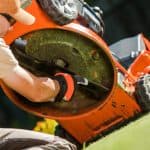
Now check the blade. Bent blade tips mean the blade has hit something. The blade is bolted to a shaft or spindle, so a hit on the blade is a hit on the part holding it, and Consumer Reports warns that the spindle could be damaged too. Up-and-down play in the blade means the bearings are worn, which it calls another expensive repair. Wear gloves, switch the engine off, pull the spark plug lead, then grip the blade and try to move it up and down. A blade that only needs sharpening is fine. A blade that has play is not.
On a petrol ride-on, work through every gear, as a manual gearbox can be damaged by grinding and missed shifts. Loose steering is usually not expensive to put right, but it can mean other parts, such as belts and pulleys, are near the end of their serviceable lives.
On a cordless mower, ask the age of the battery and watch how quickly the charge drops. Reduced run time or slow charging means the battery is ageing, and a battery left at 0% charge can lose the ability to hold any charge at all. A battery near the end of its life is a replacement bill, so ask what a new one costs before you pay.
Faults You Can Live With and Faults That Mean Walk Away
Cheap faults first. A mower that cuts unevenly and leaves a straggly lawn usually has a dull blade, which you can sharpen or replace. Read our guide to sharpening a dull mower blade for the method.
Clumps, vibration and hard pushing point to a clogged deck, which a wire brush clears. Hard starting and stalling point to a spark plug, which Which? says to replace every year, and our piece on cleaning a mower spark plug covers the job. Stale fuel is drained and replaced. Each is a reason to ask for a lower price.
Now the walk-away list. A bent blade or a damaged spindle. Play in the blade. Dirty oil together with a dirty filter and sediment in the tank, which together say the mower was never looked after. A cordless mower with a tired battery and no price for a new one. A worn drive belt is a grey area. Which? warns that replacing a belt can be complex, so treat a squeaking, weak drive as a job for a professional and get a quote before you buy.
One cheap fault is a discount. Two or three signs of neglect add up to a long list of bills. A seller who will not let you start the mower cold, or who gets vague about how long they have owned it, has told you what you need to know.
How to Keep a Good One Running (and When to Buy New Instead)
If the mower passes, change the oil, fit a fresh spark plug and start with fresh fuel. Run the mower until the tank is empty at the end of each season, or add a fuel stabiliser to stop the petrol degrading. Our guide to putting a mower away for winter shows the full routine.
If the seller’s price plus the repairs you can see adds up to near the price of a new entry-level mower, buy the new one and keep the warranty. If the mower has a fault from the walk-away list, a written quote from a repairer will tell you the real cost before you commit. A good used mower is a fine buy at the right price. A worn one is somebody else’s problem.