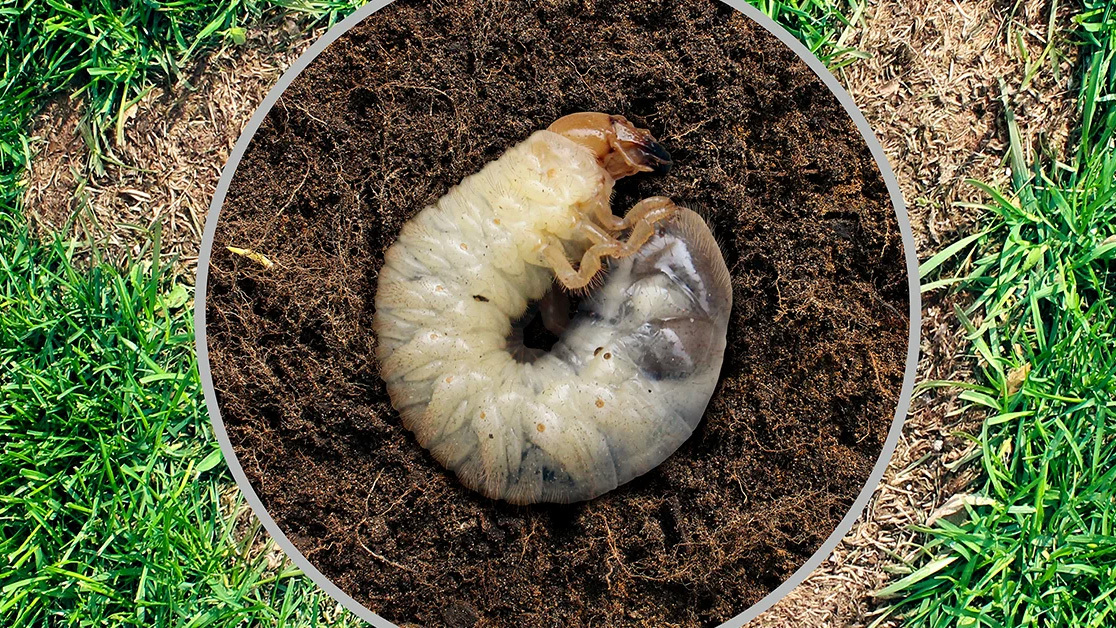
If a small cloud of pale moths lifts off the grass every time you walk across the lawn on a warm evening, the lawn is trying to tell you something. The moths themselves do no harm. Their offspring do. The caterpillars that hatch from the eggs those moths scatter feed at night on grass blades and stems, then hide down in the thatch by day. In warm summer weather they can turn a thick green lawn into thin, ragged, brown patches within a fortnight. The damage is treatable and largely preventable once you know what to look for, so the worst thing you can do is mistake it for ordinary summer drought and reach for the sprinkler.
How to Tell Caterpillars From Drought
Drought damage and caterpillar damage look similar from the kitchen window, which is exactly why so many people treat the wrong problem. The difference is on the ground. Grass under drought stress turns an even straw colour across the whole area and the blades stay intact, just dry. Caterpillar damage is patchy and the blades are visibly chewed, notched along the edges or sheared off close to the crown. Get down on your knees and part the grass with your fingers. If the turf is being eaten, you will often find small green or brown pellets sitting in the thatch, which are the droppings, and the grass will lift away with very little resistance because the stems have been severed near the base.
One of the clearest tells is the birds. Starlings, blackbirds and crows are far better at spotting a caterpillar problem than most gardeners, and a sudden interest in one part of the lawn, with birds stabbing their beaks down into the turf each morning, almost always means there is something living and feeding below the surface. The damage tends to show from mid to late summer, just as a drought-stressed lawn would, but a true dormant lawn greens up again within days of a good soak. A lawn that stays thin and keeps spreading its bare patches after watering is being eaten, not dried out. Crane fly larvae, the leatherjackets that do similar root damage, are a close cousin and worth ruling out with the same checks.
It helps to know what you are dealing with. The moths you disturb are the adults of lawn-feeding caterpillars, and in a warm summer they can run through two or even three overlapping generations, which is why damage that seems to ease off in early summer can flare up again weeks later. Each female scatters scores of eggs across the turf as she flutters low over the grass at dusk, and those eggs hatch within a week or two into the larvae that do the feeding. Because the generations overlap, you will often find caterpillars of several different sizes in the same soap test, and a spread of sizes is the sign of an established, breeding population rather than a passing visit. That is your cue to treat sooner rather than gambling on the lawn growing through the damage on its own.
The Soap Test That Confirms It
Before you spend a penny on treatment, prove the caterpillars are there. The soap flush test costs nothing and takes ten minutes. Mix two tablespoons (about 30ml) of ordinary washing-up liquid into a watering can holding roughly 8 litres (2 gallons) of water, then drench a patch about one square metre (a square yard) at the edge of the damaged area, where healthy grass meets dying grass. The soap is a mild irritant that drives soil-dwelling larvae up to the surface to escape it. Within five to ten minutes you should see caterpillars wriggling up through the grass: tan, grey or green, usually 10 to 20mm long, often with rows of dark spots along the body.
The number you find tells you whether to act. A handful of larvae across a square metre is normal in any lawn and the grass will outgrow them. More than five or six in that small patch, especially with visible feeding damage nearby, means the population has tipped past what the lawn can shrug off and treatment is worthwhile. Run the test in the late afternoon or early evening rather than the morning, because that is when the larvae have moved up close to the surface ready for their night of feeding, and the flush works faster.
How to Treat Them Without Wrecking the Lawn
Start with the biological option, because it is safe around children, pets and wildlife and it targets the larvae without touching anything else. Beneficial nematodes are microscopic worms that hunt down soil-dwelling caterpillars, enter their bodies and kill them within a few days. A pack of lawn nematodes such as Nemasys (around £12 to £15, roughly $15 to $19, treating up to 100 square metres) is mixed with water and applied through a watering can or hose feeder. The one condition that decides whether they work is moisture and warmth: apply in the evening, water the lawn before and after, and keep the soil damp for two weeks, because nematodes travel through films of water in the soil and die if it dries out. Soil temperature needs to be above about 12 degrees C (54 degrees F), which by mid-summer is easily met.
If the infestation is heavy and spreading fast, a Spinosad-based insecticide gives quicker knockdown. Spinosad is derived from a naturally occurring soil bacterium and is approved for use on many edible crops, which gives a sense of how targeted it is. Products such as BugClear Ultra (around £12, roughly $15) or a Monterey-style garden insect spray (around $25 for 470ml in some markets) list caterpillars on the label. The timing is the part most people get wrong. Apply in the late afternoon, never the morning. The larvae feed at night, so they need to be chewing on treated leaf tissue for the spinosad to be eaten, and spinosad breaks down in sunlight, so a morning spray is half spent before the caterpillars even wake up. Spot-treat the active patches plus a margin of healthy grass around them rather than blanket-spraying the whole lawn.
Stop the Moths Coming Back
Killing this generation is only half the job. Egg-laying moths are drawn to particular kinds of lawn, and you can make yours far less appealing. A thick thatch layer is both the nursery and the hiding place, so a lawn with more than about 1cm (half an inch) of spongy thatch is asking for trouble; raking or scarifying to thin it out removes the shelter the larvae rely on by day. Avoid pushing soft, sappy growth with heavy nitrogen feeds in the middle of summer, and avoid frequent shallow watering, because lush, over-watered, over-fed turf is exactly what female moths seek out for laying. Watering deeply and less often builds a tougher, deeper-rooted sward that copes far better with the feeding that does happen.
Outdoor lighting plays a quiet role too. The adult moths are drawn to lights on warm nights, so a porch or patio light left burning through the evening pulls them in and concentrates egg-laying nearby. Switching it off, or fitting a motion sensor, makes a measurable difference over a season. Once the larvae are under control, help the lawn recover by raking out the dead material, overseeding the thin patches with a grass blend that matches the rest of the lawn, and keeping the seedbed moist until the new grass is up. Give it a light feed only once the seedlings are established. Leave an active infestation untreated and the consequence is stark: in warm weather a colony can strip a patch down to bare soil within one to two weeks, and bare soil is an open invitation to weed seeds and to the next generation of moths, so a small problem in July becomes a major renovation in August.