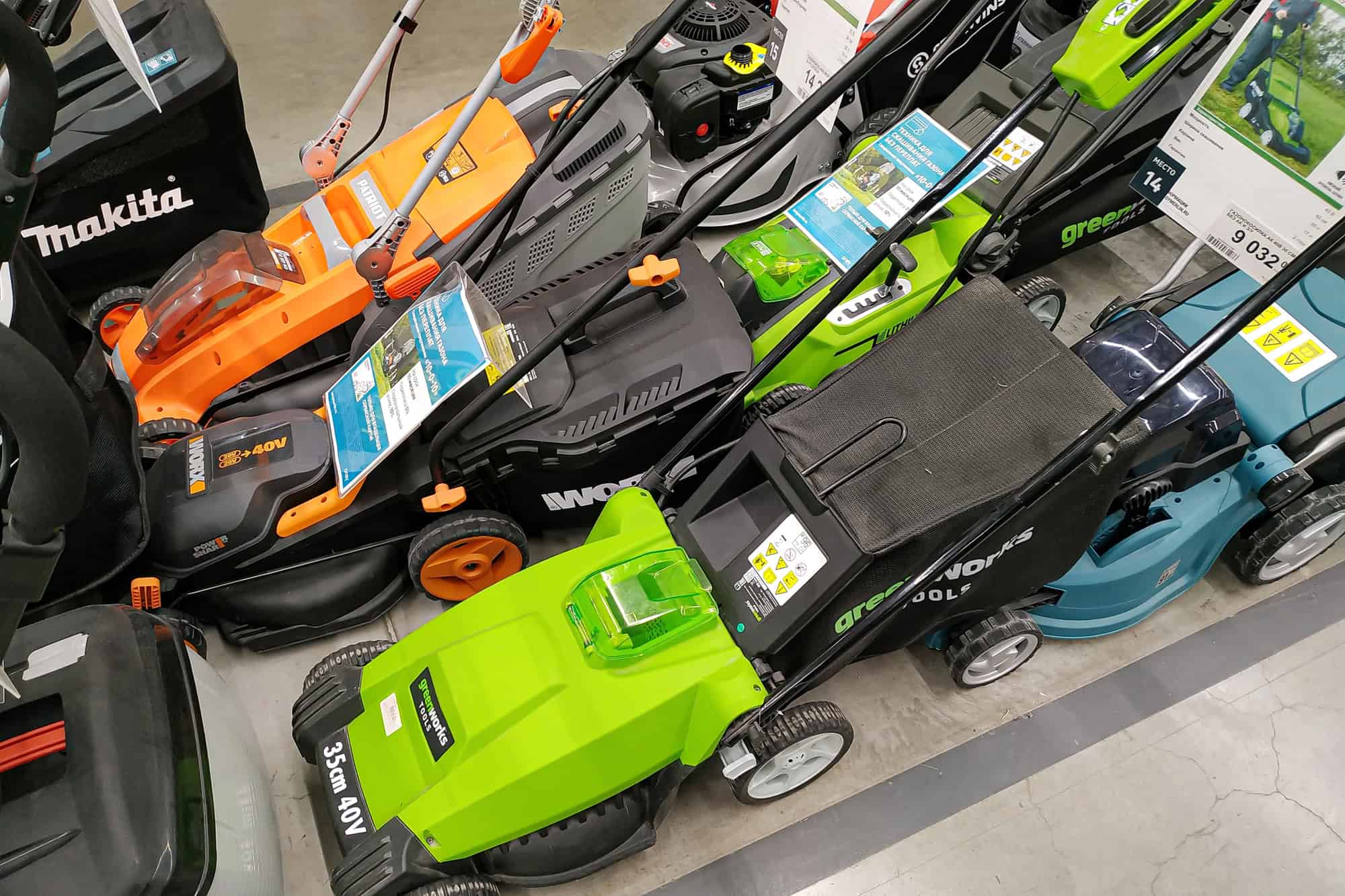
A mower at £120/$150 and a mower at £600/$750 will both cut grass on the day you buy them. The difference is what happens over the years that follow, and where the extra money goes is not a mystery. You are paying for a stronger motor, a deck that resists damage, a cutting blade that holds an edge, a drive system that saves your back, and a warranty that reflects how long the maker expects it to last. Knowing which of those things you actually need stops you from overspending on a small flat lawn and from underspending on a big or awkward one.
The Motor Is the First Place the Money Goes
On a battery or mains mower, the single biggest jump in quality between budget and premium is brushed versus brushless motors. A brushed motor uses carbon brushes that physically rub against a spinning contact to deliver power. They are cheap to make, which is why you find them in mowers under about £150/$190, but the brushes wear down, create friction, waste energy as heat and eventually need replacing or kill the motor. A brushless motor uses electronics instead of physical contact, so there is nothing rubbing and wearing. It runs cooler, draws less from the battery for the same cutting power, makes less noise and lasts far longer. That is why a brushless mower costs more up front and why it is the feature most worth paying for if you buy cordless.
The practical result shows up in thick or damp grass. A cheap brushed motor bogs down and stalls when it meets a dense patch, because it has little reserve power and sheds energy as heat. A brushless motor holds its blade speed under load, so the cut stays clean and the deck does not clog. On petrol mowers the equivalent gap is between a no-name engine and a known unit from an established engine maker, where the better engine starts more reliably after winter, holds its tune and has parts you can still buy in five years. Our guide on why battery mowers have become the best choice for most gardens goes deeper on the petrol versus battery decision.
Deck, Blade and Drive: Where Durability Lives
The deck is the housing the blade spins inside, and it comes in plastic, aluminium or steel. A moulded plastic deck is light and will never rust, which suits a small mower you lift in and out of a shed, but it can crack if you clout a tree root or a kerb, and a crack usually means the whole mower is scrap. A steel deck is the toughest and shrugs off the knocks that crack plastic, at the cost of more weight and the need to clean it so it does not rust where the paint chips. Aluminium sits in between, resisting rust like plastic while standing up to impact better. On a premium mower the deck is also shaped to manage airflow, lifting the grass upright before the blade meets it and then driving clippings into the collector or chopping them fine for mulching. A cheap flat deck collects badly and clogs in damp grass, which is the most common complaint owners have within the first season.
The blade and the way it is mounted are easy to overlook. Budget mowers ship with a thin stamped blade in soft steel that goes blunt within a few mows, and a blunt blade tears the grass rather than slicing it, leaving ragged tips that pale and brown within a day and let in disease through the wound. A better mower carries a thicker blade in harder steel that holds its edge for a full season and can be sharpened many times. If your mower throws yellowing tips a day after cutting, the blade is usually the reason, a problem we cover in detail in our piece on yellow tips that mean blunt blades, not disease.
Then there is the drive. A push mower has none, so you provide all the effort. A self-propelled mower drives its own wheels so you only steer, and that is the feature that turns a tiring chore into an easy one on anything sloping or larger than a small square. Self-propulsion costs more because it adds a gearbox, a drive belt or motor and a clutch, but on a big lawn or a hilly one it is the upgrade your knees and back will thank you for. On a small flat lawn it is weight and complication you do not need, so a simple push mower is the smarter buy.
Matching the Spend to Your Lawn
The honest answer to how much to spend is that it depends almost entirely on the size and shape of your lawn, not on how green you want it. For a small flat lawn up to about 200 square metres (around 2,150 square feet) that you mow once a week, a budget brushless cordless mower or a mid-price corded electric at £120 to £250/$150 to $310 will do everything you need for years. Spending more buys runtime and drive features you will never use, so it is wasted. The mistake here is overbuying a heavy self-propelled machine for a postage-stamp lawn.
For a medium lawn of 200 to 600 square metres (2,150 to 6,450 square feet), the £250 to £500/$310 to $625 band is the sweet spot, and it is where a brushless motor, a metal deck and self-propulsion start to pay for themselves in time saved and a cleaner cut. For a large lawn over 600 square metres, or one with slopes, long grass or rough edges, underspending is the real risk. A cheap mower asked to do that work overheats, stalls, wears out its brushes and drive belt in a couple of seasons and ends up costing more than the better machine would have. Here the £500/$625 and up bracket, or a wider deck to cut the job time, is money well spent. If your lawn is genuinely large, a ride-on mower chosen to match the ground is the place to start.
One last thing the extra money buys is the warranty, and it tells you more than any sales sheet. A budget mower typically carries a one or two year warranty, while a premium machine often comes with three to five years on the motor or engine. A maker does not put a five-year warranty on a product it expects to fail in three, so the warranty length is a fair guide to how long the manufacturer believes its mower will last. Buy the machine your lawn actually demands, keep the blade sharp and the deck clean, and the difference between cheap and expensive stops being about the price tag and starts being about how many summers the mower gives you.
The Running Costs Nobody Mentions
The purchase price is only part of what a mower costs you, and the gap between cheap and expensive often widens once you own it. The biggest hidden cost on a cordless machine is the battery, because batteries lose capacity over years of charging and eventually need replacing, and a replacement pack can cost a third or more of the price of a new mower. The better brands use a battery platform shared across many tools and keep the same fitting for years, so you can buy a fresh pack or borrow one from another tool long after purchase. A cheap own-brand mower with a sealed or oddball battery can be left unusable the day that single pack dies, because no replacement is sold.
Spare parts tell the same story. A known brand sells blades, drive belts, grass boxes and air filters for a decade, so a worn part means a cheap fix rather than a new mower. With a budget machine, those parts are often simply not available, so a snapped drive belt or a cracked grass box turns the whole thing into scrap. Before you buy, check whether you can actually order a replacement blade for the model, because if you cannot, you are buying something disposable. A mower that can be serviced and repaired for years is cheaper over its life than two or three throwaway machines, even when its sticker price is higher.