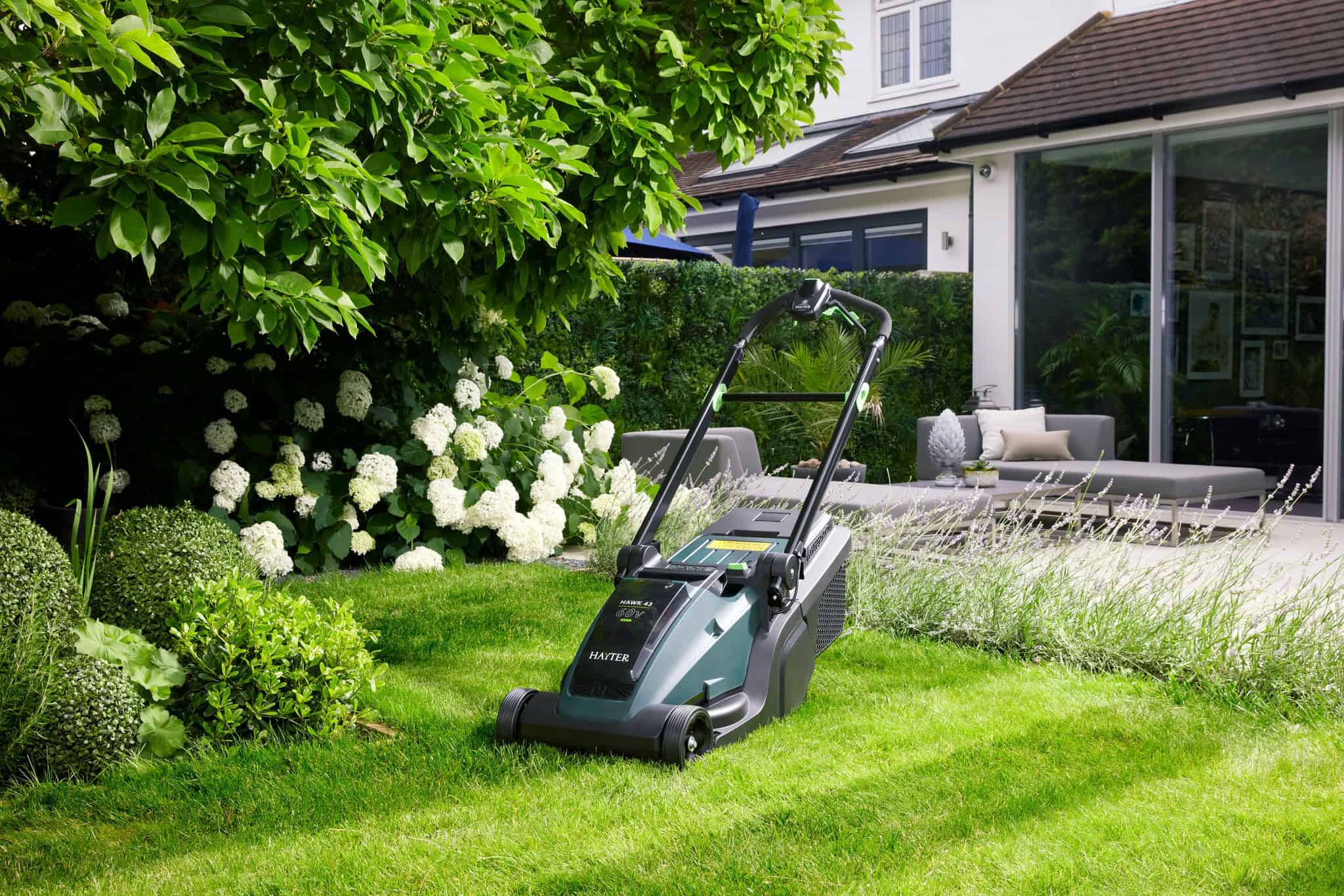
If you want the dark and light banding you see on a cricket square or a formal park lawn, the single feature that delivers it is a rear roller, and Hayter has built its reputation on rotary mowers that carry one. A roller mower bends the grass as it passes, and it is that bending, not any difference in cutting height, that produces the stripe. Get the model matched to your lawn size, keep the blade sharp, and a Hayter will lay down lines that look like they were cut by a professional groundsman.
The Rear Roller Is the Whole Trick
A lawn stripe is an optical effect, not a cutting effect. As the mower moves forward, the roller pressed against the turf behind the blade flattens each grass plant in the direction of travel. Grass bent away from you reflects light off the broad, flat face of every blade, so it looks pale and silvery. Grass bent towards you shows you the cut tips and the shadows beneath, so it looks dark. Mow one pass up the lawn and the next pass back down, and the alternating direction of the bend creates the banded pattern. Walk to the far end and look back, and the light and dark swap over, which is proof that the grass itself is all cut to the same length.
This is why a hover mower or a mower that runs on four wheels with no roller cannot stripe. There is nothing pressing the grass flat in a consistent direction. Hayter fits a full-width rear roller on its Harrier and Hawk ranges, and on the Harrier models that roller is split down the middle. The split lets the two halves turn at different speeds when you steer at the end of a run, so the mower pivots without one side of the roller dragging and scuffing a bald arc into the turf. A solid one-piece roller tends to tear the lawn on tight turns, which is the first thing that spoils an otherwise clean finish.
The roller does a second job that has nothing to do with looks. It lets the mower bridge the edge of a border or a path so the cutting deck can hang slightly over the edge, giving you a cleaner finish along the boundary and reducing the strimming you have to do afterwards. If you want to understand the striping effect in more detail, our guide on how to mow lawn stripes like a professional groundsman walks through the technique pass by pass.
Which Hayter Suits Your Lawn Size
Hayter splits its roller mowers mainly by cutting width, and the right width depends on how much grass you have and how much time you want to spend on it. The number in each model name is the cutting width in centimetres, so a Harrier 41 cuts a 41cm (16 inch) swathe and a Harrier 56 cuts 56cm (22 inches). A wider deck means fewer passes and a quicker job, but it also means a heavier machine that is harder to turn in a small space.
For a small to medium lawn up to around 400 square metres (about 4,300 square feet), the Hawk or the Harrier 41 is the sensible pick. The Hawk 43 with auto-drive and a 60-volt battery sits around £679/$850, and being cordless it starts on a button with no fuel, oil or pull cord to worry about. For a flat formal lawn up to roughly 500 square metres (about 5,400 square feet), the Harrier 48 is the classic choice. The petrol Harrier 48 with variable speed drive runs at about £1,065/$1,330, while the cordless Harrier 48 body sits lower, around £499 to £549/$625 to $690 before you add a battery and charger. Step up to the Harrier 56 or the four-wheel steel-bodied Osprey if you are mowing a large or rougher lawn where the extra width and a tougher deck earn their keep.
Two features are worth paying attention to when you compare models. Variable speed lets you match the drive to your walking pace rather than being dragged along at a fixed speed, which makes a real difference on a long lawn. The blade brake clutch, fitted to the BBC versions, stops the blade while the engine keeps running, so you can empty the grass box or cross a gravel path without restarting a petrol engine each time. If you are weighing petrol against battery in general, our breakdown of why battery mowers have become the best choice for most gardens covers the trade-offs in full. Hayter also runs a seasonal promotion through the main mowing months that bundles free gifts with certain models, so it is worth checking what is included before you buy.
What You Give Up, and the Mistakes That Flatten the Finish
A roller mower is not the right tool for every garden, and it is fair to be clear about the cost. The roller adds weight, so a Hayter is heavier to push and to lift up a step than a lightweight plastic-decked mower, and the rear roller design does not cope as well with very long, tussocky or wet grass as a high-wheeled rotary. A roller mower also costs more than a basic supermarket mower of the same width, because you are paying for the roller assembly, a heavier deck and a build designed to last many seasons rather than a few. For a small, purely functional lawn where you do not care about stripes, that money is better spent elsewhere.
If you do buy one, three mistakes will rob you of the finish you paid for. The first is a blunt blade. A roller mower presses the grass flat right after the blade passes, so any ragged, torn tips left by a dull blade are pushed down and put on display, and within a day those torn tips turn pale brown and the whole lawn looks tired. Keep the blade sharp, and read our guide on how to sharpen your mower blades for the cleanest cut if you have never done it. The second mistake is cutting too short. Stripes show best at 25 to 40mm (1 to 1.5 inches) because there is enough leaf length to bend and catch the light. Scalp the lawn down to 15mm and there is nothing left to lay over, so the pattern fades and you also stress the grass into the bargain.
The third mistake is sloppy lines. The stripe is only as straight as your first pass, so pick a fixed point at the far end of the lawn, a fence post or a tree, and walk towards it without staring at the front of the mower. Overlap each pass by a few centimetres so you do not leave an uncut sliver between the bands, and always mow in straight parallel runs rather than curving with the edge of the bed. To deepen the contrast for a special occasion, mow the lawn once, then turn ninety degrees and mow it again, or finish with a single pass around the perimeter to frame the pattern. Do that with a sharp blade on a dry lawn and a Hayter will give you the kind of finish that makes neighbours slow down at the gate.
Keeping the Roller and the Stripe Sharp
A roller mower rewards a little upkeep, and neglecting it is the slow way to lose the finish that made you buy it. After each cut, brush or scrape the build-up of cut grass off the roller and out from under the deck, because a roller caked with compacted clippings no longer presses the grass flat evenly and starts to smear rather than stripe. Wet grass clippings left to dry on a steel deck also trap moisture against the metal and begin the rust that eats into the housing over a few seasons. A two-minute clean while the deck is still damp and the clippings wipe away easily saves a much bigger job later.
Once or twice a season, check that the roller turns freely and that the split halves on a Harrier still rotate independently, as a seized roller bearing will drag and scuff the turf on every turn. Keep the blade sharp and balanced, top up or change the engine oil on a petrol model at the intervals in the handbook, and store the mower somewhere dry over winter with the battery removed and charged to around half on a cordless machine. Look after a Hayter this way and it will keep laying down clean lines for fifteen or twenty years, which is the real reason these mowers cost what they do and why so many are still cutting lawns decades after they were bought.