
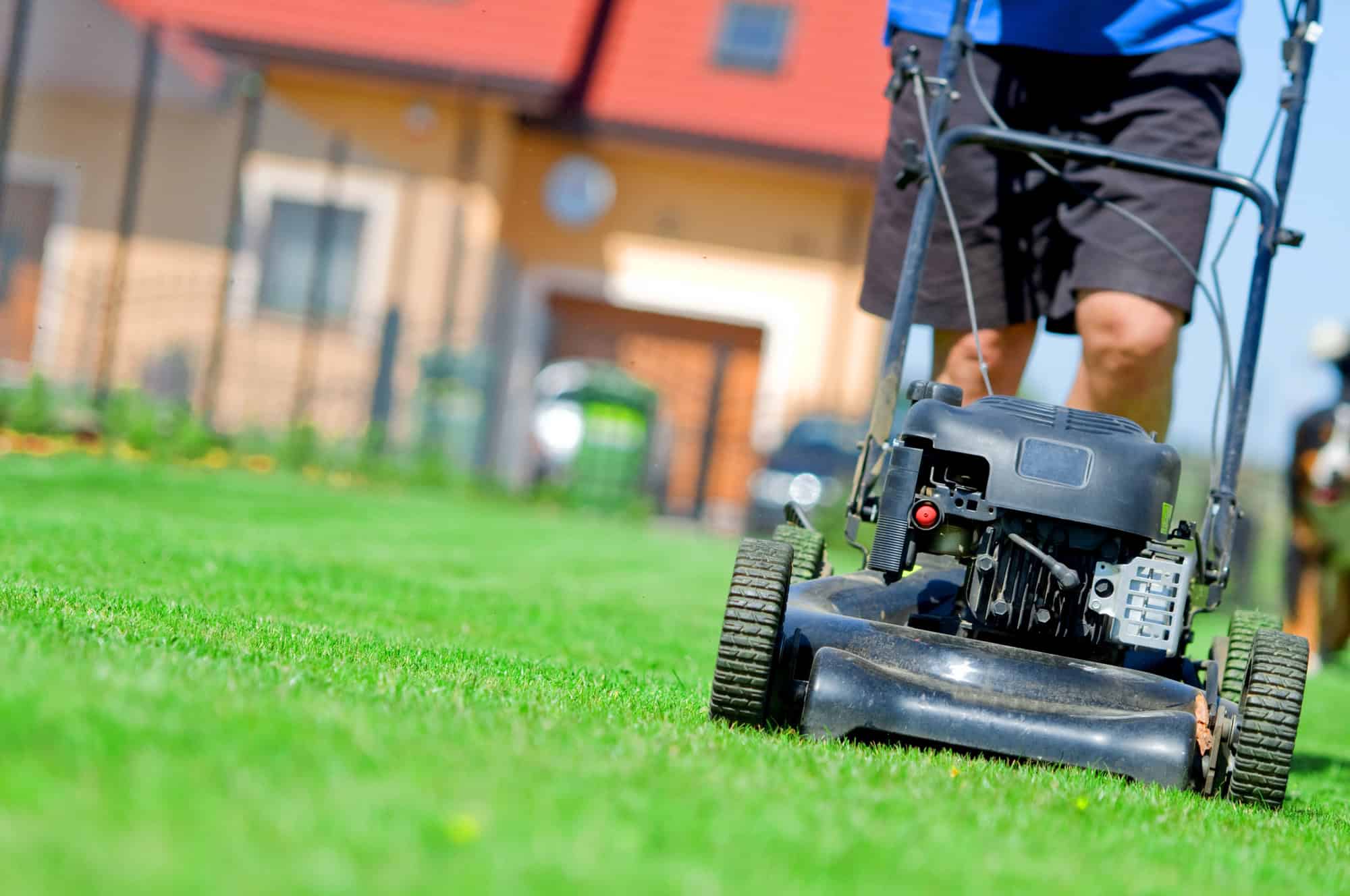
If you push your mower up and down the garden in the same tramlines every week, you are slowly working against your own lawn. The grass starts to lean, the cut looks worse over time, and on heavier soil you may notice faint channels appearing where the wheels always run. The fix costs nothing and adds no time: change the direction you mow every single cut. Go up and down one week, side to side the next, then on the diagonal, then the other diagonal. That one change keeps the grass standing upright, spreads wheel wear so ruts never form, and gives a noticeably cleaner finish.
It sounds like a small detail, and it is the kind of thing generic mowing advice skips entirely. But professional groundsmen treat changing direction as a basic rule, and the reasons go to the heart of how grass grows and how soil behaves under repeated pressure.
Why Grass Develops a Grain
Grass blades are not rigid. They bend, and over time they take a set in whatever direction they are repeatedly pushed. A mower does two things on every pass: the wheels and the airflow from the blade push the grass forward, and the cutting blade shears the tips. If every pass runs the same way, week after week, the whole sward begins to lie over in that direction. Turf specialists call this the grain, and once it is established it has real consequences for the cut.
A blade that is leaning when the mower reaches it does not get cut cleanly. The mower pushes it flat instead of shearing it, so it springs back up uncut moments after the mower has passed. The result is a lawn that looks unevenly cut even straight after mowing, with longer streaks running in the grain direction. People often blame this on a blunt blade or a mower that is set too high, when the real cause is that the grass has been trained to lie down. Mow across the grain, from a fresh direction, and those same leaning blades stand up into the path of the cutter and get sheared properly. The cut instantly looks tidier and more even.
There is an upside to grain too, and it is the secret behind lawn stripes. The light and dark bands on a striped lawn are simply grass bent toward you, which looks dark, and grass bent away from you, which catches the light and looks pale. Stripes rely on a roller bending the grass in alternating directions on a single cut. That is controlled, deliberate grain across one mow. The problem is the uncontrolled grain that builds up when you mow the same way every week for months. If you want to understand how groundsmen use grain on purpose, our guide on mowing lawn stripes like a professional covers the technique in detail.
Why Repeated Wheel Tracks Cause Ruts and Compaction
The second reason to vary direction has nothing to do with the blades and everything to do with the soil. A mower is heavy, and a self-propelled or ride-on model is heavier still. Every pass, the wheels press down on the ground with the full weight of the machine plus the person behind it. When the wheels travel the same line week after week, they press the soil in those exact strips over and over.
Soil that is pressed repeatedly becomes compacted. The air pockets between soil particles, which roots need for oxygen and which water needs to drain through, get squeezed out. Compacted strips hold less water, drain poorly, and starve the roots beneath them of air. The grass along those lines grows thinner and weaker than the grass either side, and on clay soils, which compact far more readily than free-draining sandy ground, the wheels can eventually press visible channels or ruts into the surface. Once a rut forms it tends to deepen, because the wheels naturally drop back into the groove on the next pass.
Changing direction spreads that wheel pressure across the whole lawn instead of concentrating it on a few lines. No single strip takes the load every week, so no strip compacts faster than the rest and ruts never get the chance to establish. It is the same principle as rotating where you park a car on a gravel drive. Spread the load and nothing wears out prematurely. This is most important on damp ground, so if the lawn is soft after rain, it is worth waiting for it to firm up before mowing at all, because soft soil compacts and ruts far more easily than dry soil.
It helps to picture what compaction does at the level of the soil itself. Healthy turf soil is around half solid particles and half pore space, and that pore space is split between water and air. Grass roots breathe through those air-filled pores, taking in oxygen and releasing carbon dioxide, and soil organisms that recycle nutrients depend on the same air. When a wheel presses the same strip every week, it raises the bulk density of the soil there, which is a measure of how tightly packed it is. The pores collapse, air is driven out, and water can no longer move down through the column. Roots in that strip become short and starved, the grass above grows thin and pale, and the line becomes the first part of the lawn to brown in a dry spell and the last to recover after rain. Spreading the wheel load by changing direction keeps bulk density low across the whole lawn rather than letting it spike along a few fixed tracks.
How to Rotate Your Mowing Pattern
You do not need a complicated system. A simple four-way rotation covers everything and is easy to remember if you just change to the next option each cut.
- Week one: mow in straight lines north to south, up and down the length of the garden.
- Week two: mow east to west, across the width.
- Week three: mow on a diagonal, corner to corner.
- Week four: mow on the opposite diagonal.
- Then start the cycle again.
Even alternating between just two directions, up-and-down one week and side-to-side the next, delivers most of the benefit. The point is simply that no single direction repeats two cuts running. For a striped finish, you still change the overall orientation each week, but you create the alternating light and dark bands within that single mow by turning at the end of each row and coming back the opposite way.
If you find it hard to remember which way you went last time, a simple trick is to tie the direction to something fixed, such as mowing toward the house one week and along the fence the next, or keeping a note on your phone. Robotic mowers solve the problem automatically, since most roam in a semi-random pattern that never repeats the same lines, which is one quiet reason their owners rarely see wheel ruts. A few practical notes make the habit easier to keep. Mow the perimeter first, one lap around the edge, which gives you a clean turning strip and means you can change your main direction freely without scalping the borders. Vary your starting edge as well, because always beginning in the same corner reintroduces a pattern through the back door. And keep the blade sharp regardless, because a clean cut from a sharp blade reduces moisture loss through the cut tips and helps the grass recover faster, whichever way you are mowing.
What happens if you ignore all this? Over a single season the damage is mild and reversible. Over several seasons of identical mowing, you end up with a lawn that has a permanent lean, a cut that always looks streaky, thin worn lines where the wheels run, and on clay, shallow ruts that need topdressing and reseeding to repair. None of that is inevitable. It is entirely caused by mowing the same way every week, and it is entirely prevented by the simplest change in your routine: turn the mower a different way next time.